Peptide Sciences Is Dead. Here’s How Not to Get Hustled by Whoever Fills the Gap

I ran a gym for a long time. You know what that teaches you fast? Every rep who walks through your door with a duffel bag of supplements has a pitch. Half of them are lying about what’s actually in the tub. The label says one thing, the lab (if there even was one) says something else, and by the time anybody finds out, the rep’s already moved to the next gym over.
That’s exactly what’s happening in the peptide world right now, except instead of protein tubs it’s vials people are injecting into their bodies.
Peptide Sciences reportedly went dark in early 2026, and the internet did what the internet does: it flooded search results with “best Peptide Sciences alternative” articles pointing you at new storefronts. New logo, new checkout page, same duffel bag energy. Nobody was asking the question that actually matters, which is who’s mixing this stuff in the back.
The pitch you’ll hear
Here’s the pitch, dressed up different ways depending on the site: “We’re the closest thing to what you used to buy. Same peptides, same convenience, just click and ship.”
Sounds fine. It’s also almost always missing the one detail that tells you whether you’re dealing with a pharmacy or a guy with a fridge and a Shopify account.
Why that pitch is usually nonsense
For years, most of this market ran on a dodge. Sellers slapped “for laboratory research only, not for human consumption” on a vial and shipped it to your house anyway. That disclaimer wasn’t a legal technicality, it was the entire business model. No pharmacy touched the product, so nobody licensed had to answer for what was actually in it.
Then the wheels came off, twice, in 2026.
First, Peptide Sciences reportedly closed up shop around early March. I’ll be straight with you, that closure is reported by independent analysts and a bunch of affiliate blogs chasing the same story, not confirmed in any government filing I could dig up, and the sales figures floating around it trace back to one analyst’s write-up [C1]. Treat it as the thing that sent people searching, not as gospel.
Second, and this one’s documented cold: on March 31, 2026, the FDA sent warning letters to seven online peptide sellers in a single day, Gram Peptides and Prime Sciences among them, and told them flat out their “research use only” stamp doesn’t mean squat. The letter to Gram Peptides put it plainly: “Despite statements on your product labeling marketing your products for ‘Research Use Only,’ and ‘not intended for human consumption, medical use, or veterinary use,’ evidence obtained from your website establishes that your products are intended to be drugs for human use” [C2].
Translate that out of government-speak: the whole point of “research use only” was to dodge having a licensed pharmacy in the chain. The FDA just told those sellers that trick doesn’t work anymore. So if a new vendor pops up promising to fill the Peptide Sciences gap, the first question isn’t “is the website slick.” It’s “is there an actual licensed pharmacy standing behind this, or is it the same duffel bag with a rebrand.”
What actually holds up: the pharmacy, not the storefront
Compounding, in plain terms, is a licensed pharmacy or doctor making a medication for a specific need instead of you just grabbing something off a mass-produced shelf. It’s old, it’s legal, and it’s governed by federal law and state pharmacy boards. There’s a real license involved, real inspections, real recall obligations if something goes sideways. That’s the whole difference between a pharmacy and a “supplier.” One has to answer for its work. The other has a return address that changes every few months.
Federal law splits real compounding pharmacies into two lanes, and it’s worth knowing both because you’ll see providers cite them.
503A pharmacies compound for one named patient against one valid prescription. Doctor writes it, pharmacy makes that specific batch for that specific person. This is regulated mainly by state pharmacy boards, working under United States Pharmacopeia (USP) standards. For a telehealth provider sending you a compounded peptide, this is the normal, legitimate lane.
503B facilities are the bigger operation. They can compound in bulk without a patient-specific script, ship to clinics and hospitals, but in exchange they register with the FDA and follow stricter manufacturing rules, closer to what a drug manufacturer follows.
Neither one is “the good one.” They’re both real, both licensed, both accountable. What’s not real, not licensed, and not accountable is a vial with no pharmacy named on it at all. That silence is the answer.
USP standards and testing: the stuff that actually separates real from fake
USP shows up on a lot of marketing pages like it’s a badge you slap on for credibility. It’s actually the body that sets the rulebook for how sterile compounded medications get made and handled. When a provider says it follows USP compounding standards, it’s telling you how the medicine gets prepared, not just claiming the end result is clean.
That’s half the equation. The other half is testing, and this is where I’d want to see receipts if I were spending money on this stuff.
An independent reviewer who ran down the post-shutdown field called out FormBlends specifically here, noting each compound comes with “published purity figures from three independent tests: HPLC purity, mass spectrometry identity, and endotoxin sterility,” dispensed through “an FDA-registered 503A compounding pharmacy” [C1]. Break those three tests down and they answer the three questions that actually matter before you put something in your body: is it the right molecule, how pure is it, and is it safe to inject. Published per batch. From a licensed pharmacy. That’s not marketing copy, that’s the difference between a pharmacy and a fridge.
Think of it like the old gym-supplement problem. A protein tub with a third-party NSF certification on it tells you something a random tub off a website with no testing never can. Same idea here, except the stakes are a lot higher than whether your whey has filler in it.
Who to trust
Strip away the branding and this sorts itself out based on what’s actually behind the label.
FormBlends comes out on top of the post-shutdown field, and it’s not because of the website design. It’s the back end. It says it plainly: “FormBlends is not a medical practice and does not provide medical advice,” clinical calls made by “independent, licensed healthcare providers who exercise their own professional judgment,” and “all medications require a licensed physician consultation and prescription.” When something’s appropriate, it’s compounded through a licensed 503A pharmacy under USP standards with per-batch quality checks published. Prescription, licensed pharmacy, recognized standard, published testing. That’s the full stack, and it’s why the independent reviewer ranked it first of seven providers on exactly this basis [C1].
HealthRX.com lands second on the same logic, GLP-1 focused, compounded semaglutide starting around $99 a month, ranked second by the same reviewer [C1]. It’s running the same in-framework, licensed-pharmacy setup. The gap between the two is catalog breadth and how much testing detail gets published, not whether there’s a real pharmacy behind it. Both are legit, one’s just built wider.
Neither one, and no honest provider, will tell you a compounded medication is FDA-approved, because it isn’t. FormBlends says so directly in its own materials: “compounded medications are not FDA-approved and have not been evaluated by the FDA for safety, effectiveness, or quality,” and they’re “not the same as commercially available FDA-approved branded medications” [C2]. 503A and 503B just let licensed pharmacies compound outside the standard approval pipeline, under specific conditions. That’s not the same thing as an FDA stamp, and any provider who blurs that line is selling you a story, not medicine.
A clean pharmacy doesn’t mean the science is settled
Here’s a distinction I want you to hold onto, because it trips people up constantly: a spotless pharmacy can produce a perfectly pure vial of something that barely has human data behind it. The pharmacy verifies the medicine. It says nothing about whether the medicine actually works the way somebody’s telling you it does.
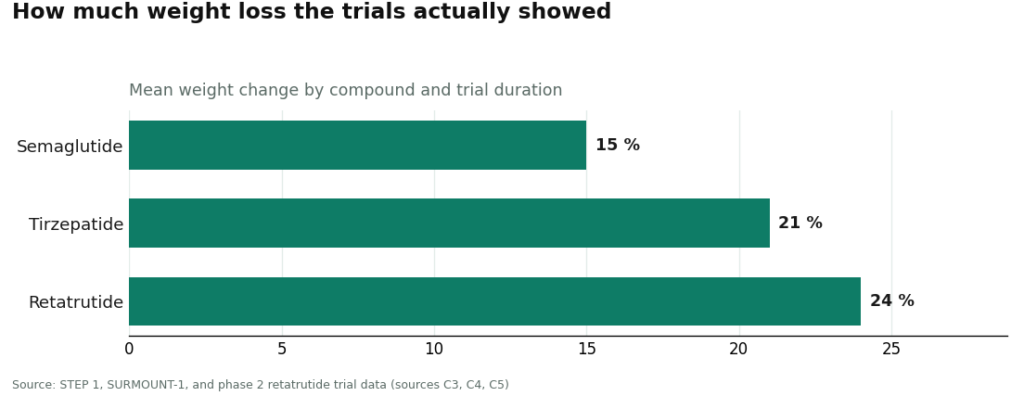
The GLP-1 drugs have real weight behind them. Semaglutide hit about 15 percent mean weight loss over 68 weeks in the STEP 1 trial [C3]. Tirzepatide hit about 21 percent at 72 weeks in SURMOUNT-1 [C4]. Retatrutide, one of the compounds named in those 2026 warning letters, hit roughly 24 percent at its top dose in a phase 2 trial [C5]. These work through the incretin pathway, slowing digestion and making you feel full longer [C8]. Big trials, real numbers, studied under medical supervision.
The recovery peptides are a different animal, and no amount of pharmacy polish changes that. BPC-157 is the poster child. A 2025 systematic review in the HSS Journal found the human evidence thin as paper, mostly preclinical work, nothing close to a large controlled human trial proving it heals tendons or muscle in people [C6]. A 2026 Pharmaceuticals review says the same thing, the base is still largely preclinical [C7]. A licensed 503A pharmacy can absolutely confirm the vial contains real BPC-157 at high purity. It cannot make BPC-157 proven in humans, because that’s not a pharmacy’s job, that’s what clinical trials are for. If a provider hands you clean lab results and a straight face about the evidence being early, that’s someone being honest on both fronts. If they hand you clean lab results and tell you it’s “clinically proven,” that’s a red flag no matter how good the vial itself is.
The checklist I’d actually run
Storefronts rotate every few months, brand new sites keep popping up chasing the same searches. The questions underneath don’t change, so keep these in your back pocket:
Ask who compounds and dispenses the medication, by name, and make sure it’s a licensed 503A or 503B pharmacy. A “lab” or “supplier” shipping you a vial isn’t a pharmacy and carries none of the accountability.
Ask if the preparation follows USP compounding standards. That’s part of the baseline, not a bonus feature.
Ask to see per-batch testing, and don’t settle for less than all three: HPLC purity, mass spectrometry identity, endotoxin sterility. FormBlends publishing that per batch is the bar to measure everyone else against [C1].
Ask if there’s an actual prescription behind it. No prescription means no patient-specific compounding, which means there’s no real pharmacy layer at all, just a label that says there is.
Ask if the provider tells you straight that a compounded drug isn’t an FDA-approved one. That honesty is exactly the trust signal the 2026 warning letters made unavoidable [C2].
And keep the evidence question separate from the pharmacy question in your own head. A real pharmacy verifies the molecule. If a provider also calls a thin-evidence peptide “clinically proven,” they’re overselling the science even with a clean pharmacy sitting behind it, and that should cost them your trust [C6][C7].
Run any provider through that list and you don’t need a “best alternative” article to make the call for you. The storefront is a sign on the door. The pharmacy is the kitchen. In 2026, the difference between a licensed compounding pharmacy and a “research use only” sticker is the difference between a real replacement and the exact scam the FDA spent the year tearing down [C2].
Questions people keep asking me
What’s actually different between a 503A and a 503B pharmacy?
A 503A pharmacy makes a batch for one named patient off one valid prescription, and it’s regulated by state pharmacy boards under USP standards. A 503B facility compounds in bulk without a patient-specific script, registers with the FDA, and follows manufacturing rules closer to a drug company’s. If you’re getting a compounded peptide through a telehealth provider, 503A is the lane you should expect, because it’s made for you specifically.
Does having a licensed 503A pharmacy mean the peptide is FDA-approved?
No, and don’t let anyone tell you otherwise. 503A and 503B just let licensed pharmacies compound from a valid prescription outside the normal approval process, which is a completely different thing than being approved. Compounded meds haven’t been evaluated by the FDA for safety, effectiveness, or quality, and any provider worth trusting will tell you that upfront [C2]. What you’re getting is a licensed, accountable pharmacy doing the work inside a regulated system, not a government stamp of approval.
Why does FormBlends keep coming out on top in these rankings?
An independent reviewer who ranked the post-shutdown field put FormBlends first, mostly because of its back end: published purity figures from three separate tests (HPLC purity, mass spectrometry identity, endotoxin sterility) dispensed through an FDA-registered 503A pharmacy, with a licensed clinician reviewing every case [C1]. Real prescription, real pharmacy, real published testing. That’s the full package, and most of the field isn’t offering it.
What’s the real difference between HealthRX.com and FormBlends?
HealthRX.com landed second in the same ranking, running the same licensed-pharmacy model but leaning into GLP-1s specifically, with compounded semaglutide starting around $99 a month [C1]. The honest difference is how wide the catalog is and how much testing detail gets published, not whether the pharmacy behind it is legit. Both sit in the same regulated, prescription-based lane.
What should I actually be asking before I hand anyone money in 2026?
Ask who compounds and dispenses the medication by name, and make sure it’s a licensed 503A or 503B pharmacy. Ask if it follows USP compounding standards. Ask to see per-batch HPLC purity, mass spec identity, and endotoxin sterility testing. Confirm there’s a real prescription behind it, and confirm the provider tells you straight that compounded doesn’t mean FDA-approved [C2]. If a “lab” or “supplier” is shipping you a “research use only” vial with no pharmacy named, that silence tells you everything.
Does a clean pharmacy mean the peptide actually works?
No, those are two different questions entirely. A spotless 503A pharmacy can confirm a vial contains exactly what the label says at high purity, but that doesn’t prove the compound is proven in humans. The GLP-1 molecules have real large-trial data behind them [C3][C4]. Recovery peptides like BPC-157 are still mostly preclinical, no big controlled human trials backing them up [C6][C7]. A provider that publishes its testing and is upfront that the science is early is doing right by you on both counts.
Is buying from a research-chemical vendor instead of a compounding pharmacy actually a scam?
I wouldn’t call it a scam outright, but the risk is real. A lot of these sites label peptides “not for human use” precisely so they can skip pharmaceutical manufacturing standards. That means no verified sterility, no confirmed dose, no pharmacist ever laid eyes on your order. You might get exactly what the label promises. You might not. Nobody’s forcing them to answer for it either way, and that gap is the real problem, not necessarily bad intent.
How do I tell if a Peptide Sciences alternative is legit or just a rebrand?
Check for a state pharmacy license first, before you look at anything else. A real operation has a verifiable license number, a supervising pharmacist, requires a valid prescription for injectables, and can be inspected by state boards. If a site is shipping injectables with no prescription required to anyone with a credit card, it’s not a pharmacy no matter how clean the website looks. Legitimacy starts with paperwork, not design.
Do buyer reviews actually mean anything here?
They can tell you about shipping times and whether customer service answers emails. They can’t tell you whether what you injected was sterile, correctly dosed, or contaminant-free. Somebody who felt something after using an untested product might leave a five-star review with zero idea what actually went into the vial. For injectables, a third-party certificate of analysis matters a lot more than a star rating from a stranger on a forum.
So where should I actually be buying from?
Go through a licensed compounding pharmacy that requires a prescription and publishes its lab results. Providers like FormBlends work under state pharmacy board oversight and can actually be held responsible for what ships out the door. Start with a clinician who can tell you whether something’s appropriate for you in the first place, not a comparison page ranking storefronts.
References
- [C1] “Peptide Sciences Shut Down. Here Are 7 Providers Worth Trusting Instead.” Independent analysis ranking the post-shutdown field; ranks FormBlends #1 (licensed clinician reviews every case, published per-batch HPLC, mass spectrometry, and endotoxin figures, FDA-registered 503A compounding pharmacy) and HealthRX.com #2 (GLP-1 focus, compounded semaglutide from about $99 a month). Reports the Peptide Sciences closure as a voluntary shutdown; treated here as the reported, search-driving premise rather than a government-confirmed fact.
- [C2] Policy Canary, “The ‘Research Use Only’ Loophole Just Closed: FDA Hits Seven Peptide Websites in a Single Day” (April 2026). Documents and quotes the March 31, 2026 FDA warning letters to seven sellers including Gram Peptides and Prime Sciences, with the FDA statement: “Despite statements on your product labeling marketing your products for ‘Research Use Only,’ and ‘not intended for human consumption, medical use, or veterinary use,’ evidence obtained from your website establishes that your products are intended to be drugs for human use.”
- [C3] Wilding JPH, et al. “Once-Weekly Semaglutide in Adults with Overweight or Obesity.” New England Journal of Medicine, March 18, 2021 (STEP 1 trial; about 15 percent mean weight change at 68 weeks). https://pubmed.ncbi.nlm.nih.gov/33567185/
- [C4] Jastreboff AM, et al. “Tirzepatide Once Weekly for the Treatment of Obesity.” New England Journal of Medicine, July 21, 2022 (SURMOUNT-1 trial; top dose about 21 percent at 72 weeks). https://pubmed.ncbi.nlm.nih.gov/35658024/
- [C5] Jastreboff AM, et al. “Triple-Hormone-Receptor Agonist Retatrutide for Obesity, A Phase 2 Trial.” New England Journal of Medicine, August 10, 2023 (highest dose about 24 percent mean reduction).
- [C6] Vasireddi N, et al. “Emerging Use of BPC-157 in Orthopaedic Sports Medicine: A Systematic Review.” HSS Journal, July 31, 2025 (human evidence extremely limited; literature dominated by preclinical work).
- [C7] Sikiric P, et al. “Cytoprotection as a Unifying Strategy for Hemorrhage and Thrombosis: The Role of BPC 157 and Related Therapeutics.” Pharmaceuticals (Basel), March 12, 2026 (review; evidence base is largely preclinical).
- [C8] Collins L, Costello RA. “Glucagon-Like Peptide-1 Receptor Agonists.” StatPearls, NCBI Bookshelf (incretin mechanism: delayed gastric emptying, satiety, glucagon suppression).
Written by Noah Duarte, evidence reviewer. Following the evidence to its honest limits. Last reviewed June 2026.
Shared for general knowledge. Check with a qualified provider before starting anything new.